It arrives in a tiny container.
A few delicate threads.
They barely seem significant.
And yet, those threads carry a story that connects landscape, farming, food and Kashmiri identity.
This is saffron.
And if you only encounter it as something sold in a shop, you miss most of the story.
To understand Kashmir’s saffron, you need to go beyond the packet.
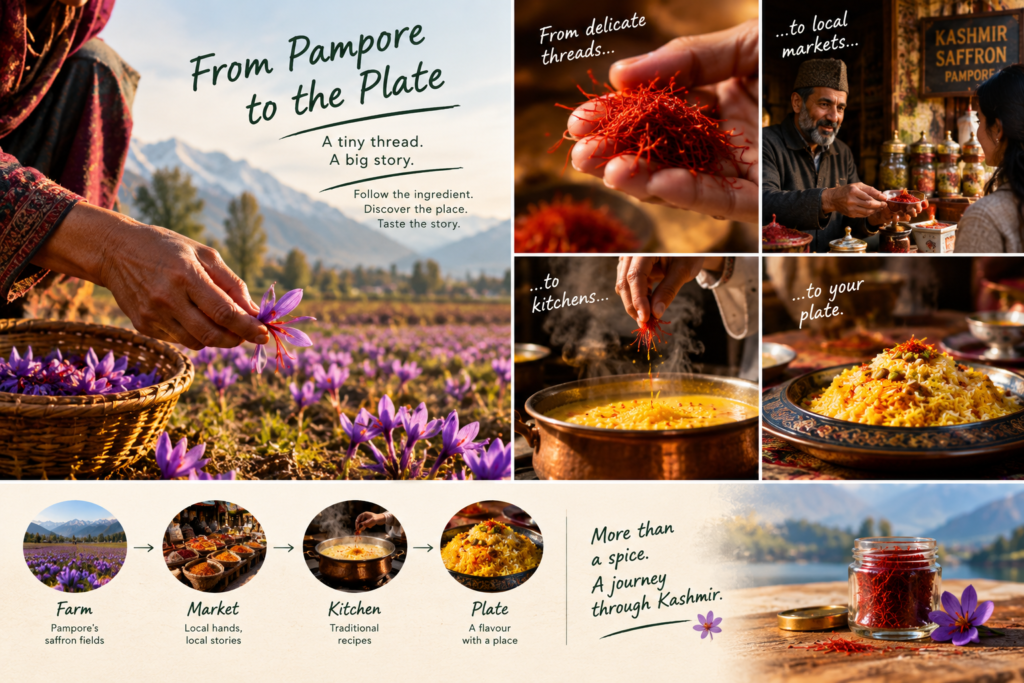
You need to follow it from Pampore to the plate.
Where the Story Begins
Saffron is closely associated with the Pampore area of Kashmir.
The landscape around Pampore has become part of the identity of Kashmiri saffron, connecting the spice not simply with a product, but with a particular place.
That distinction matters.
When we talk about food tourism, it is easy to focus on what appears on the table.
But the more interesting story often begins much earlier.
In the soil.
In the fields.
In the hands of farmers.
And in the seasons that determine the rhythm of agricultural life.
A Spice With a Landscape
Imagine encountering saffron without knowing where it comes from.
It becomes an ingredient.
Now imagine standing in the landscape where it is cultivated.
Suddenly, the ingredient has geography.
The landscape becomes part of the flavour story.
This is one of the reasons food can be such a powerful form of travel.
You don’t simply taste something.
You begin to understand where it belongs.
The Human Work Behind the Threads
Saffron is not produced by simply planting a crop and waiting for a harvest.
Its cultivation and harvesting involve careful work.
The delicate flowers and their stigmas require attention.
That human element is easy to forget when saffron is sitting in a beautifully packaged container.
Food tourism can change that.
Instead of asking only:
“How much does saffron cost?”
ask:
“Who grew it?”
That question takes you from shopping to understanding.
Why Food Stories Matter
A destination’s cuisine is often treated as entertainment for visitors.
But food can reveal much more.
It can tell us:
- What grows locally
- What the climate allows
- What communities traditionally value
- Which ingredients are seasonal
- How recipes move between generations
- How agriculture connects with everyday life
Saffron is one thread in that larger story.
And Kashmir has many more.
From Field to Kitchen
The most interesting culinary journey does not end at the farm.
Follow the ingredient further.
How is saffron stored?
How is it used?
Which dishes or drinks feature it?
How does it appear in celebrations?
How do different cooks use it?
These questions turn an ingredient into an experience.
Instead of simply tasting saffron, you begin to understand its role.
The Difference Between Buying and Experiencing
There is nothing wrong with buying saffron in Kashmir.
But imagine leaving with something more valuable than a small box.
Imagine knowing:
where it came from,
how it was cultivated,
why the region is associated with it,
how it is used,
and what the people behind it do.
Now the purchase has a memory attached to it.
That’s the difference between souvenir tourism and story-driven travel.
Build a Culinary Journey Around One Ingredient
This idea can be extended beyond saffron.
Choose one ingredient.
Then follow it.
Farm → Market → Kitchen → Plate
The same framework could be used to explore:
- Kashmiri walnuts
- Traditional bakery ingredients
- Seasonal produce
- Local herbs
- Spices
- Apples and other regional produce
Each ingredient becomes a doorway into another part of Kashmir.
Imagine a Day in the Valley
Your morning begins in the agricultural landscape.
You learn about saffron cultivation.
Later, you visit a local market.
You talk about ingredients.
Lunch introduces you to Kashmiri cuisine.
In the afternoon, you learn how food and tradition intersect.
By evening, you sit down for a meal.
The saffron on the plate is no longer anonymous.
You have followed its journey.
That is culinary travel at its best.
Why The Kashmir Reset Looks at Food Differently
The Kashmir Reset is not interested in treating food as another item to tick off an itinerary.
Food is a way into the destination.
A way to meet people.
A way to understand landscapes.
A way to slow down.
A way to listen to stories.
And sometimes, a way to understand a place better than any sightseeing tour can.
The Next Time You Taste Kashmir…
Don’t just ask:
“What is this?”
Ask:
“Where did this come from?”
Then keep following the answer.
You might discover that a tiny saffron thread can take you from a field in Pampore to a kitchen, a family tradition and finally to your plate.
And suddenly, dinner isn’t just dinner anymore.
It’s a journey.
Follow the ingredient.
Discover the place.
Taste the story.